
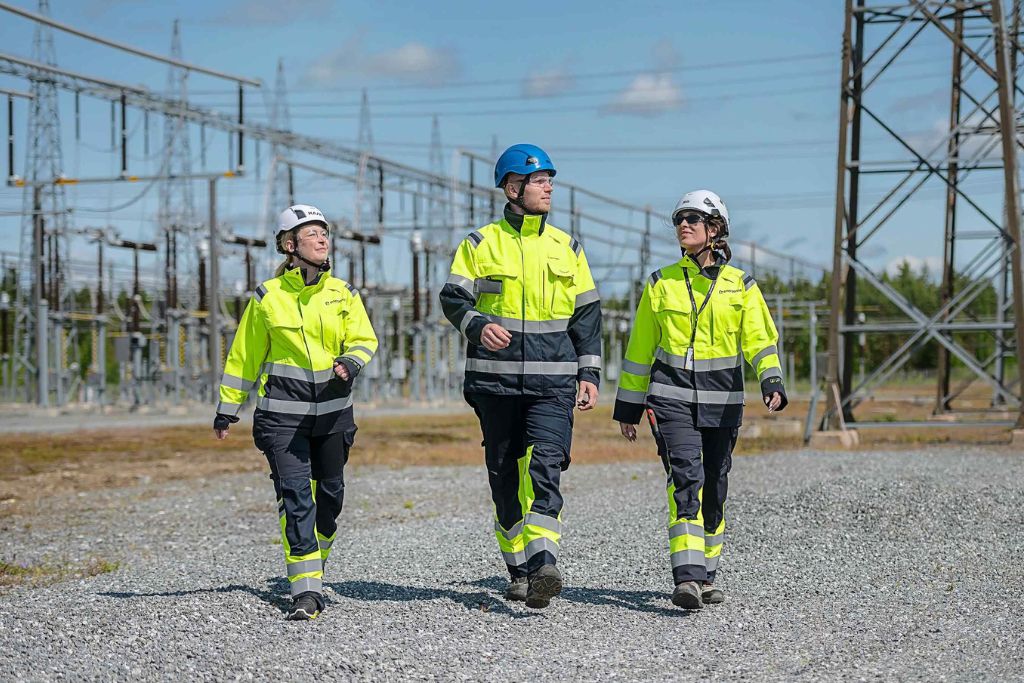
Enersense wanted to strengthen its employees’ expertise on carbon handprint and its utilisation in support of its customers’ sustainability and energy transition goals. OpenCO2net served as a partner in the planning and implementation of a training program related to carbon handprint.
Enersense, operating in Finland, the Nordics and the Baltics provides key services for future society. The company manages its customers’ energy transmission and generation, the industrial energy transition, telecommunications, and data centers, for example. Enersense is a partner to many businesses seeking to develop their own operations and to find more sustainable solutions.
The carbon handprint training and workshop were tailored to Enersense’s needs
The training program was developed in collaboration between Enersense and OpenCO2net. The first phase consisted of in-house training on climate action and the carbon handprint. OpenCO2net provided guidance to Enersense in planning the training objectives and the content of the materials.
Following this, Enersense worked with OpenCO2net’s experts to design a workshop tailored to the company’s needs. The workshop was led by OpenCO2net’s founder and CEO, Sari Siitonen. Sari has been involved in developing carbon footprint-related methods and practices in Finland. After the workshop, all ideas and insights, as well as the workshop materials, were compiled into a workshop report to support Enersense’s ongoing climate work.
The key to successful training lies in ensuring that it meets the company’s current needs as effectively as possible. Enersense’s employees had prepared well for the workshop and familiarized themselves with the topic in advance. This allowed the workshop to proceed smoothly, sparking a productive discussion about the potential climate benefits of the company’s services. Although Enersense’s staff already had a good understanding of what a carbon handprint measures and how it can be used, the training further deepened their knowledge.
“We want to carry out effective and measurable climate action. OpenCO2net helped us understand ways and opportunities to improve our carbon handprint and offer more sustainable options to our customers.”
The Corporate Social Responsibility Manager at Enersense, Nina Karisalo
What kind of clarifications and requirements does changing legislation bring to sustainability reporting?
With the introduction of the directive strengthening consumer protection (Empowering Consumers for the Green Transition) and the related national legislation, even stricter requirements are being placed on companies’ environmental communications. The carbon handprint is a comparative claim subject to strict requirements. The requirements regard, among other things, the reliability of calculations, the transparency of assumptions, as well as the consistent determination of the baseline and the handprint calculation method. The workshop featured a lot of productive discussion about baseline selection and how to reliably substantiate environmental claims related to the carbon footprint. Although the legislation officially applies to B2C commerce, in practice its effects also extend to business-to-business communication and marketing.
For companies to communicate positive climate impacts with credibility, the claims must be based on reliable and verifiable data. To determine a carbon handprint, LUT University and VTT have developed a carbon handprint method. It provides detailed guidelines on how to measure a positive carbon handprint and how to communicate it.
This training program has provided Enersense with a solid foundation for developing its climate initiatives and communicating its environmental impact. After the workshop, the company will have several excellent ways to improve its operations and find new ways to advance both its own climate efforts and those of its customers.
“We actively offer our customers options for improving their carbon handprint. The training provided us with tools for developing our carbon handprint in a customer-centric way.”
Nina Karisalo
The training programs organized by our experts and tailored to our clients’ needs effectively enhance the knowledge and expertise of the entire company. The topics covered in OpenCO2net’s training sessions can be tailored to your company’s needs. They may include topics such as carbon footprint or handprint calculations, setting emissions reduction targets, climate strategy, or environmental communication. Through these training sessions, you can enhance your staff’s expertise and ensure your company’s competitiveness as the demands of sustainability efforts and stakeholder expectations continue to grow. The OpenCO2net platform also features a carbon handprint calculator based on a calculation method developed by LUT University and VTT.
