

Under the CSRD, companies must carefully evaluate their emission reduction targets and the process for setting them. According to the Corporate Sustainability Reporting Directive, these targets must align with the Paris Agreement. Many companies have already set their targets based on the Science-Based Targets initiative (SBTi). What should you know about SBTi, and how can your company set such a target?
The term SBTi may already be familiar, as more than 13,000 companies worldwide have joined the initiative, with over 11,000 having set approved climate targets. As of June 2026, 235 Finnish companies are participating and have established either near-term targets or, in addition, net-zero targets.
What is SBTi?
The Science Based Targets initiative (SBTi) essentially means that a company reduces its emissions in line with the Paris Agreement’s 1.5°C target. SBTi is an international organization formed by the UN Global Compact, the environmental organization WWF, the climate reporting organization CDP, and the World Resources Institute (WRI).
How is Science Based Targets initiative set?
Setting an SBTi target and the steps involved depend on the size of the company. For SMEs, the process is slightly more straightforward and easier than for large companies. The basis for setting the target is a company-level emissions calculation based on the GHG Protocol standards. SMEs should have calculated at least scope 1 and 2 emissions, while larger companies should have calculated scope 1-3 emissions, covering the company’s entire value chain.
The SBTi guidelines therefore vary slightly depending on the size of the company and the sector. If a company operates in an energy-intensive sector, it has its own sector-specific guidelines and targets. Companies operating in these sectors, irrespective of their size, must follow the sector-specific guidelines. The energy-intensive sectors are:
- aluminium
- apparel and footwear
- air transport
- buildings
- chemicals
- cement
- financial institutions
- forest, land and agriculture
- ICT
- land transport
- maritime
- oil and gas
- power
- steel
What is the SBTi process like?
The SBTi process for large companies consists of five steps, having been slightly simplified. First, the company registers for the SBTi on the SBTi portal. Next, a baseline year is selected against which future emission reductions will be measured. The baseline can be up to five years in the past, so a distant year cannot be chosen. Once the targets are set, they are submitted to SBTi, along with a reliable emissions calculation. SBTi starts a validation process, during which further questions regarding the company’s emissions calculation, targets, and activities might be adressed. After validation, the company receives an approval message. Simultaneously, a schedule for publishing the company’s name and targets on the SBTi website is provided. The company receives instructions on communicating about SBTi. During the monitoring phase, the company must establish a plan for emissions calculation, reporting, and reduction measures for the future to achieve its targets.
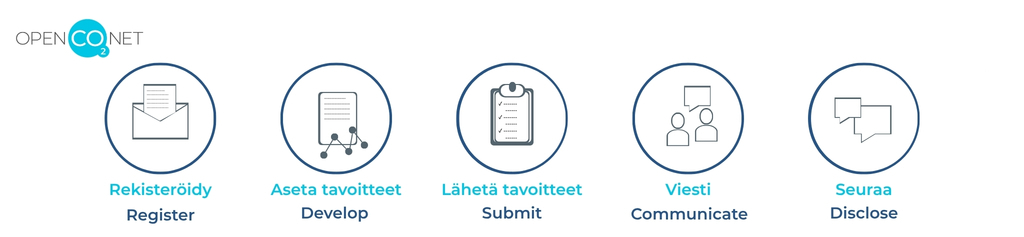
As of summer 2025, all companies, both large and small, can set their targets directly through the SBTi portal. Other changes are also on the horizon, as the SBTi published the new SBTi Corporate Net-Zero Standard V 2.0 in June 2026. The new standard will be implemented in phases. Companies that have already registered and started the SBTi process this year, or that will set targets later in 2026, may continue to use the old version of the standard. 2027 will be a transition year, during which companies may switch to the new version if they wish. Starting in 2028, the new version will be mandatory for all, and the old version will be phased out.

SBTi – Near-term target and net-zero target
As stated earlier, a reliable and high-quality emissions calculation is the foundation for SBTi targets. The company must conduct a calculation based on GHG Protocol standards for the year it wants to set as the baseline for its SBT, known as the base year.
A company can set a near-term target and, if desired, a net-zero target. The near-term target can be set for 5–10 years from the base year, committing the company to reducing its emissions within this period in line with the Paris Agreement. In addition to the near-term target, the company can also set a net-zero target either at the same time or in the following years. With this target, the company commits to reducing its emissions by 90% compared to the base year. The target year for achieving net-zero falls between 2040 and 2050, depending on the company’s sector.
Why choose SBTi?
Setting SBTi targets and implementing emission reduction measures requires some effort from companies, which may seem unnecessary or challenging. If a company fails to meet its targets or cannot respond to SBTi’s questions and requirements, the term Commitment removed may appear next to its name on the SBTi website, potentially harming its reputation. Why Are Companies Still Joining the SBTi?
SBTi is globally recognized and has gained prominence in recent years as a key part of companies’ climate efforts. The targets set through the initiative are ambitious, and meeting them requires companies to make real emission reductions.
Under the CSRD, companies must set their own emission reduction targets and report them in their sustainability reports. The CSRD does not specifically require commitment to the SBTi initiative, but it requires companies to set targets in line with the Paris Agreement. If a company commits to the SBTi, and receives validation for its emission reduction targets, no additional justification is required for sustainability reporting. Many companies that have set SBTi targets also set targets for their supply chains. Therefore, the need for SBTi targets may also arise from the supply chain, even if your company is not subject to the direct requirements of the CSRD.
OpenCO2net’s tools and up-to-date emission factors allow companies to calculate their greenhouse gas emissions in accordance with the GHG Protocol and ESRS E1 standards. Comprehensive emissions calculation also serves as the basis for setting an SBTi target. Our experts have helped companies of various sizes in different sectors set emissions reduction targets, and 100% of the companies we’ve assisted have successfully validated their SBTi targets. If you have questions about emission reduction targets, please contact us using the form below, and our experts will schedule a free consultation with you and answer your questions.
